Showing posts with label television. Show all posts

Wednesday, September 28, 2011

Where are the voices of anger?

We are living in turbulent times my friends.  Most of us live under a cloud of uncertainty - an omnipresent gloom that permeates every waking moment.  How will I pay my rent?  Keep my house? Find a job?  What happens if I get sick?  What kind of a world will my kids live in?  How will our country move forward into these uncertain times without fracturing into a million splinter groups of special interests, each with voices raised in hyperbole and hysteria.

And throughout all this upheaval, what has the medium of cinema had to say about all this?

I'm waiting...


In the 60's and 70's, the turmoil of society was reflected in its cinema.
Movies like Easy Rider, Woodstock, Bonnie & Clyde, The Graduate, Dr Strangelove, Straw Dogs, Taxi Driver, Midnight Cowboy, and Night of the Living Dead represented their times with bold, revolutionary statements, new directions, and a cold hard look at societies' issues.

Vietnam had fractured the country, but starting with MASH in 1970, filmmakers were already attempting to deal with the horrors of war and its effects on our country. 
Then came Coppola's brilliant love letter to chaos and darkness, Apocalypse Now, and eventually, more mainstream efforts like The Deer Hunter, Coming Home, Platoon and Born Under the Fourth of July.


In 1976, Paddy Chayefsky and Sidney Lumet seemed to speak for a whole nation with their brilliant satire, Network:
"I'm mad as hell and I'm not going to take it anymore!" 

In the 80's and 90's a new wave if independent cinema burst in the scene.
Movies like Sex, Lies & Videotape, Do The Right Thing, Slackers, Clerks, Drugstore Cowboy, Stranger Than Paradise all reflected the new attitudes of their era.

In 1999 two films, American Beauty and Fight Club presented very different, but uniquely bold, amazing and heartfelt visions of modern-day existential malaise.
They challenged their viewers to take a closer look at their materialistic priorities.


And then, it all seemed to stop.

Since Sept 11, 2001 this country has gone through multiple ongoing traumas, yet through it all, the filmmakers of today have been incredibly absent from engaging in an intelligent discourse with society that should be helping us all process an unprecedented amount of conflict, upheaval and crisis:

- coping in a post 9/11 world: terrorism; 2 wars waging for a decade; the loss of basic rights under the Patriot Act.

- economic collapse: massive unemployment; foreclosures.

- environmental calamity: global climate change; industrial pollution and devastating oil spills.

- major shifts in the workplace: outsourcing; longer hours; lower wages; increased productivity at the cost of leisure time; 24/7 intrusion of work into our private lives.

- runaway development of advancing technology that outpaces our ability to understand its effects.

- non-stop consumption of images, data and trivial information, with little to no time to actually process any of it.

- a completely dysfunctional government.

- inequal wealth distribution and a vanishing middle class.

- corruption by wall street and corporate interests.

- a major national shift away from being the world's superpower to just another player.

- a nation of repeated violence and tragedy - mass killings - rampage killings, murder/suicides.

- a mass media that fans the flames of ignorance and hatred.

- an oppressive, permeating undercurrent of paranoia that a nightmare apocalypse is just around the corner - 2012, Doomsday, The End of Times.

What have our current filmmakers had to say about these unprecedented turbulent times?  Art can be a crucially important vehicle by which society processes confusing, disruptive and complex new ideas and situations.

While there have been many very good documentaries that have addressed some of these complex issues, I believe that narrative films can do even more to help a society work through its traumas, as cinema works at the subconscious level of myth and archetype. 

I can honestly think of only a couple narrative movies that have attempted to deal with any of these issues: the academy award winning The Hurt Locker and the excellent Up in the Air.
There may be more, but even with these two fine films, neither was really a rallying cry for a generation - neither became a national speaking point, or a prism by which society could direct and clarify its arguments.

I'm still waiting...

I don't necessarily expect Hollywood to be making these kinds of films.  It's just not in their nature (or economic interests) to do so.  But where the hell are the indie voices of indignation, frustration and revolution?

Television seems to have done somewhat better in this regard.  There have been a number of excellent series that have dealt with many of today's pressing issues.
Shows like Rescue Me, Boardwalk Empire, Treme, The Wire, Breaking Bad, The Walking Dead, Louie and Generation Kill represent the times we are living in and the turmoil we all face.
yes, I know Boardwalk Empire is set in the 20's - it is clearly an allegory for today's corrupt political system and economic disparity

But Cinema, that great medium of dream and drama, where are you when we need you the most?  Please prove me wrong - please present me with challenging, revolutionary ideas and visions that reflect our troubled times.  Please shock me with outrageous dramatic representations of war, political corruption, economic upheaval and personal tragedy.

And then please give me stories of hope, compassion and humanities' capacity to do good.

Please tell me it's going to be okay.

So I can sleep at night.

Tuesday, December 28, 2010

Best TV Shows of the Decade

I decided to skip over the Top 10s of the year and go right for the big daddy - the Best of the Decade.

First up - Television.
 This last decade of TV represents for me, the golden age of television.  Simply put, it is the best television has ever produced:


The Wire - The best. Ever. David Simon's brutally honest dystopian vision is the gold standard.


The Sopranos - The one that started it all - and relaunched Journey's career.


Breaking Bad - Fearless. Bold. Funny. Visionary. Brutal.


Mad Men - Tone-perfect subtle portrayal of the pivot point of a decade and a man's journey to find his authentic self.


Deadwood -  David Milch's foul-mouthed Shakespearean western is a multi-layered tour-de-force.


Band of Brothers - Epic portrayal of the realities of war in the mid-century.


Dexter - Puts all those CSI clone shows to shame.  Michael C. Hall carries the show with nothing but subtle facial expressions.


Curb Your Enthusiasm - Seinfeld synthesized into a crack-like addictive journey into Larry David's warped vision of ultimate social discomfort and humiliation.


Battlestar Gallactica - Sci-Fi told on an epic scale while maintaining its focus on character.


Rescue Me - Foul-mouthed.  Daring.  Brutally honest.  Went head-first into post 9-11 territory that no one else with a sane mind would touch.  Thank you Dennis Leary.


These brilliant and revolutionary shows easily match up against the best television of any decade - perhaps even the best narrative dramas of any medium.  If will be interesting to see if the next decade can live up to these achievements.  Clearly the most creative minds are now working in television - where the showrunners (usually writers) can maintain control of their vision.

Not one of these shows was produced by traditional network television.  And no one cares anymore - the era of the networks is dead.  My children couldn't tell a network from cable or pay tv or YouTube or hulu or Netflix.  It is all simply visual storytelling that comes to them from a box in our home - or on a mobile device on the go.  The revolution is already over.

The best of the rest:

Six Feet Under
The Office
Rome
Entourage
Generation Kill
Friday Night Lights
30 Rock
True Blood
Survivor
The Daily Show With John Stewart
Lost

Next up:  Best Horror Movies of the Decade

Sunday, May 23, 2010

Lost finale in a nutshell


Willy Wonka: So who can I trust to run the factory when I leave and take care of the Oompa Loopa's for me? Not a grown up. A grown up would want to do everything his own way, not mine. So that's why I decided a long time ago that I had to find a child. A very honest, loving child, to whom I could tell all my most precious candy making secrets.
Charlie Bucket: So that's why you sent out the golden tickets!
Willy Wonka: That's right. So the factory is yours, Charlie. You can move in immediately.
Grandpa Joe: And me?
Willy Wonka: Absolutely.
Charlie Bucket: But what happens to the rest...?
Willy Wonka: The whole family. I want you to bring them all.

Tuesday, April 27, 2010

The New Golden Age of Television

Interesting blog post by Keith Balmer about the cornucopia of amazing television shows in recent years. 

He echoes what I have been feeling - anyone who says there's nothing good on tv has been living with their head in the sand for the past ten years.

This is as good as it gets folks - set your DVRs, rent 'em from Netflix, catch 'em on Hulu - do yourself a favor and bask in the sunlight of this golden era of tv: Breaking Bad, Treme, The Pacific, Justified, Modern Family, Lost, Parenthood, and soon the new season of Mad Men.

This is by no means a definitive list, there are many other great shows out there.

And then go back and catch up on The Sopranos, Six Feet Under, Rescue Me, Deadwood, Dexter, Battlestar Gallactica, Rome, Brotherhood, Curb Your Enthusiasm, Generation Kill, Weeds, True Blood, and of course, The Wire.

You'll be glad you did...

Sunday, March 21, 2010

Reality TV Wreckage

A few years ago, both my wife and I started watching what we thought was a more "high-brow" variety of reality-tv - shows on Discovery, TLC, Food Network (you know, the educational channels), that focused on real-life families and their unique jobs or circumstances.  I got hooked on American Choppers both for its how-to look at custom chopper building (something I knew nothing about), and for its fascinating examination of the antics of the Teutul family.  My wife closed in on Jon & Kate Plus 8, a peek into the "wow, thank goodness that isn't us" world of newborn sextuplets and the harried lives of Jon & Kate as they struggled to get through each day.

Let's not kids ourselves, we knew we weren't watching PBS, but at least it seemed a little better than a night with The Bachelor, or Temptation Island.  The shows appeared to be a watered-down version of the premise of the highly acclaimed "Up" series of films (7 Up, 7 Plus Seven, 21 Up, etc.) that followed the lives of 14 typical British youth and examined them every seven years - providing insights into not only their individual lives, but complex societal issues of race, class and the human condition.

However, a strange thing started to happen to both our little "slice-of-life" shows. What began as a peek inside a custom chopper garage soon became a parade of logos, as Paul Sr. and the boys began assembling bike after bike for Intel, Gillette, HP, and other corporate clients. Curiously, that struggling Gosselin family of 10 suddenly got a bigger van and a bigger house and vacations to Disney World and ski trips to Utah.

And then all hell broke loose.  As the people on the shows became more successful, as their lives got easier, their homes bigger and their bank accounts fuller, they began to tear at each other like rats in a cage.  Eventually it became clear that the shows were no longer about ordinary people and their daily lives - what we were watching were extraordinary insights into how media attention itself affects the average person, and the seemingly inevitable downfall that follows.


Saturday, February 27, 2010

David Simon's Treme on HBO - why television is kicking Hollwood's ass

For those of you who never watched The Wire - shame on you.
Shame, shame, shame.

I'm forever puzzled by people saying there's nothing good on tv.  We are living in a golden era of television with the last ten years providing us with some of the finest shows ever produced.

The Sopranos started it all and raised the bar all those who followed:  Six Feet Under, Deadwood, Dexter, Battlestar Galactica, Lost, The Office, Rescue Me, Mad Med, Breaking Bad - I could go on and on.

While Hollywood continued to focus on big-budget spectacle, television became a nurturing haven for brilliant writers.  The long-format of a broadcast season allowed writers to delve into controversial topics and breathe nuance and complexity into their characters.

I'd take this year's Breaking Bad or Mad Men over any of the Oscar nominated films of this year.  And as much as I like and admire The Hurt Locker, I have to say that Generation Kill did a far better job of shedding a light on the horrors and contradictions of modern-day war.
Which brings us to The Wire, which I consider to be the finest television series ever produced.  David Simon created a masterpiece of institutional dysfunction and the people who bang their heads against it every day.  Whether you're a cop, a senator, a teacher, a drug-dealer, an addict, a student, a journalist, or just someone trying to make it through the day, the overwhelming reality is that society is broken and those who try to swim against the tide get crushed.


And now Simon has a new series on HBO that only he could tackle - the intricate social, racial, artistic and political gumbo that is a post-Katrina New Orleans.

When Treme premieres in April, do yourself a favor - watch it.

Thursday, January 7, 2010

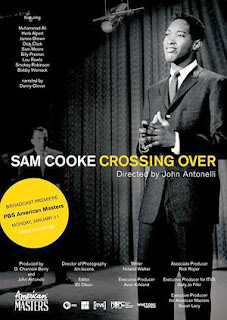
Sam Cooke Opening Title - behind the scenes

Sam Cooke: Crossing Over premieres Monday, January 11 at 9 p.m. on PBS as part of their American Masters series.

I worked on this documentary for my good friend, director John Antonelli, on and off for about 5 years.  There were many iterations as he awaited final funding but I'm thrilled that he was able to stick with it, complete the project, and have it presented on such a prestigious showcase as American Masters.

For the finished show, I did some editing work, as well as designing the opening title and animating many of the photo moves that appear throughout.

As you can see in the title sequence below, we wanted to treat the photos with a subtle 3D effect to add interest and movement to the still photos that are a big part of telling the story of this influential soul singer.


This particular 3D effect has become very popular in recent years and has appeared on numerous documentaries that have aired on Discovery channel, History Channel and PBS.  I'd like to to give you a glimpse behind the scenes, into the process that creates some of the eye-catching animation that you see on tv everyday.

To achieve this effect, I used the industry stalwart tools:  Photoshop and After Effects.


First, I was given a hi-resolution scan of the original photo of Sam Cooke on the Ed Sullivan show.  John and I discussed the themes of his documentary and agreed that this image did a great job of visually representing the ideas of Cooke crossing over from his gospel roots, to a white pop music culture.
I then worked on the photo in Photoshop by cleaning up the dust and scratches and adjusting the levels so the tones were a bit darker and richer.

For this effect to work, I must create two separate "plates" from the photo - a background plate, and a foreground plate.  Essentially, I "cut out" what I want to pop into the foreground by creating a matte in Photoshop and isolating Sam from the background.
Once I've cut him out,  I then need to go back to the background plate and touch-up the photo to create what would be behind Sam if he wasn't standing there in the photo.  In other words, when the camera moves around in the image, there has to be something behind Sam that is revealed as the perspective changes.  To do this I use the Clone Stamp Tool to copy sections of the photo and paint them into the hole I created by cutting Sam out.  I also may use the brush tool to paint as well.  You can see that I don't need to fix the entire hole I created, just enough to create the illusion that what's behind Sam is a complete curtain and floor.
I also decided to blur and darken the background to make Sam "pop" even more.

Once that's all done, I now have a photoshop file with two layers - the top layer with Sam cut out, and the bottom layer with the background darkened and additional curtains and floor painted-in.
Now it's time to import this file into After Effects and create the movement.

In After Effects, I create a new composition ("comp") and bring the file with these layers into that comp.  I then let After Effects know that I want the layers to exist in three-dimensional space (X,Y and Z axis) by checking the 3D option next to the layers.

You'll see that I also added spotlight effect to break up some of the negative space on the left.

I then add a new "camera" to the comp which is what I will use to animate the image.  Essentially, I will move the camera around in the image and what the camera "sees" is what I will see.
Next I need to separate the layers in Z space so that the top layer exists a certain distance above the bottom layer.  This is a trial and error process to determine how "high" I want the top layer to be.  I move the camera around a bit to see how the perspective changes.  For this project, John and I determined that we wanted to the 3D effect to be fairly subtle and unobtrusive, so I only set the top layer a little bit above the bottom layer.

However, since I've moved the top layer in Z space, it now appears out of position and much larger than it did before.  To correct this, I need to scale it back down and reposition it back to it's original composition.
This too takes some trial and error.

Now that the image is how I want it, I can create my move by setting keyframes for my camera at the starting point, moving the camera through the image until I get something I like, and then setting keyframes at the end point.  This process takes quite a bit of fidgeting to get the motion and the timing just right.
You can see from this viewpoint that this is not a "true" 3D effect, there is no depth or "thickness" to anything - it is more like a pop-up book - but it is effective nonetheless.

You'll notice that in the final title sequence there is a lot more going on - flash-jumps, text effects and color and texture effects on Cooke's face at the end, all of which introduced a lot more work to get to the final product that you'll see on tv.

As you watch the show, keep a look out for more of these 3D photo moves - some of the photos have standard pans and zooms, but we sprinkled these 3D moves throughout the film at key moments and on particularly striking images.

I hope this has given you a little insight into the work I do and into the process of creating animated effects for video and film work.